
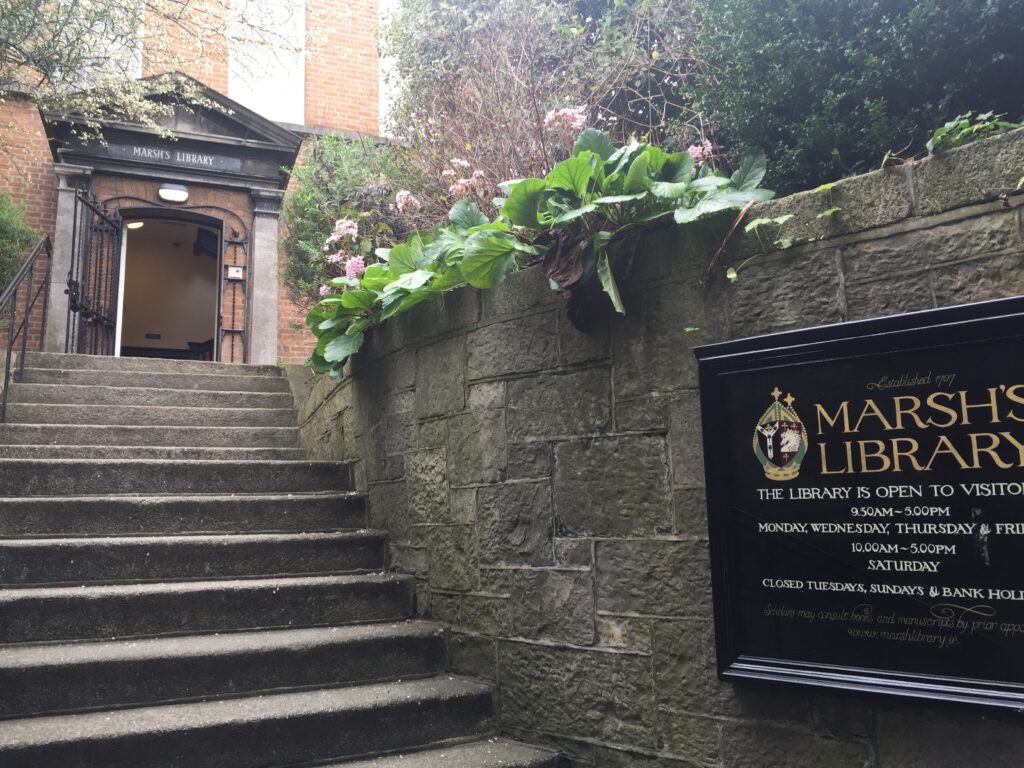
Some secret libraries hide behind locked doors. This one hides in plain sight, and it locked its readers in instead. Marsh’s Library became the inspiration for my beloved fictional Darbyshire Memorial Scholars’ Library in The Lost Teachings of Dead Monks, which you can read free in my online Library.
Marsh’s sits beside St Patrick’s Cathedral in the center of Dublin, and yet it feels removed from the city around it. The entrance is modest. The stone staircase doesn’t prepare you for what waits at the top: two long galleries of dark oak bookcases, rolling ladders, leather bindings, and windows softened by three centuries of Irish light.
At the far end are three enclosed reading alcoves fitted with wire doors. They’re called the cages. Readers were once locked inside them with the books they’d requested, not because the books were dangerous but because the readers couldn’t be trusted.
That alone would earn Marsh’s a place on my list of secret libraries. But the building also holds books torn open by gunfire during the Easter Rising, the table where Bram Stoker and James Joyce studied, the collection of a refugee who carried his library out of France, and at least one ghost who may still be searching the shelves for a letter that was never found.
A Library for Anyone Who Could Read
Narcissus Marsh was an Anglican clergyman, a scholar, and a book collector with a wide streak of curiosity. Born in England in 1638 and educated at Oxford, he studied Hebrew and the other languages of biblical scholarship, then kept going: mathematics, astronomy, natural history, music.
He arrived in Ireland in 1679 to become Provost of Trinity College Dublin, and what he found there frustrated him. Trinity had a substantial library, badly managed. Books went missing, students could barely use the collection, and the general public couldn’t get in at all. Dublin’s booksellers, he complained, offered little beyond “trifles and pamphlets.”
So he began imagining something unusual for his era: a library built for the reading public. Libraries existed before Marsh’s, of course, but they belonged to universities, churches, monasteries, and wealthy collectors. Access depended on who you were and where you belonged. Marsh wanted a place where anyone capable of reading could come and study.
It wasn’t a lending library. You couldn’t take a novel home for the weekend; the books were reference works, many already old and valuable, and they stayed in the building. Still, the principle was radical for 1700. Knowledge shouldn’t be locked inside a university or a rich man’s cabinet. It should be open for public use.
The Lost Teachings of Dead Monks — Marsh’s Library and its locked cages inspired the fictional Darbyshire Memorial Scholars’ Library in this novel. Read it free in my online Library, or buy it direct on Curios.
Building a Library Beside St Patrick’s Cathedral
By the time Marsh became Archbishop of Dublin in 1694, he lived at St Sepulchre’s Palace beside St Patrick’s Cathedral, and he chose a corner of the palace garden as the site for his library.
William Robinson, Ireland’s Surveyor General, designed it. Marsh wanted echoes of Oxford’s Bodleian Library, which he knew well, and Robinson gave him a long, two-story, barrel-vaulted building running south to north. The First Gallery and the original reading room were finished in December 1703. When those filled up quickly, a narrower Second Gallery was added at a right angle around 1708 or 1709.
The architecture is a treasure in its own right. The oak bookcases rise about thirteen feet, topped with carved scrollwork, small gilded flowers, and mitres. The entrance staircase has spiraling supports called barley-sugar twists, a decorative form that has rarely survived in Dublin.
Even the shelving had a logic. Heavy books went low. Smaller volumes, including the controversial pamphlets, went high. The books are still organized by bay and subject, and many still sit in the exact positions assigned to them roughly three hundred years ago.
The result doesn’t look like a modern library arranged for efficiency. It looks like an intact thinking machine from the early Enlightenment, built to hold everything an educated European scholar could know at the start of the eighteenth century.
An Act to Preserve a Public Library Forever
The building existed by 1703, but Marsh wanted more than a handsome room full of his own books. He wanted the library protected as a permanent institution, beyond the reach of heirs and accidents.
In October 1707, the Irish Parliament passed An Act for Settling and Preserving a Publick Library for Ever. The act placed the building and its collections under a body called the Governors and Guardians, and Marsh’s Library is still governed under it today, amendments aside.
The library could now formally open to the public. For roughly its first century and a half, it was the only public library in Dublin.
One of its early Governors was Jonathan Swift, then Dean of St Patrick’s next door. Swift attended the Governors’ annual meetings, though his relationship with Marsh himself was not exactly warm. That seems fitting for a library whose history contains almost as many strong personalities as rare books.
Four Libraries Within One
The shelves at Marsh’s aren’t the result of one man buying whatever caught his eye. The historic collection was assembled mostly from four personal libraries, and each one preserves the mind of its original owner.
The First Gallery holds about 10,000 books that belonged to Edward Stillingfleet, an influential English theologian who died in 1699. Marsh bought the collection from Stillingfleet’s son for £2,500, an enormous sum at the time. Theology, history, law, politics, classics, science. Many of those books still stand where they were placed when the library opened.
The books in the Old Reading Room belonged to Élie Bouhéreau, the library’s first Keeper, and his story is as compelling as anything on the shelves. Bouhéreau was a physician, a scholar, and a French Huguenot from La Rochelle. After Louis XIV revoked legal protections for French Protestants in 1685, Huguenots could convert or flee. Bouhéreau fled, with his wife and seven of their eight children, and he brought his library of some 2,200 books out with him. As a condition of becoming Marsh’s first librarian, he placed that collection in the new institution, in exchange for a salary and an apartment on the ground floor. His books still surround the table where Ireland’s most famous literary visitors would later sit.
The left side of the Second Gallery holds Marsh’s own collection: works in Irish, Hebrew, Arabic, Aramaic, Syriac, and Ge’ez, plus mathematics, astronomy, and natural history, including a first edition of Isaac Newton’s Opticks. Across from Marsh’s shelves are the books of John Stearne, a former Dean of St Patrick’s and later Bishop of Clogher, whose collection runs heavier on literature, drama, poetry, and Irish affairs.
Walk from one end of Marsh’s to the other and you pass through four different minds. The shelves preserve what these men studied, argued about, valued, and feared losing.
The Readers Who Could Not Be Trusted
Marsh intended readers to have access to knowledge. Some readers interpreted access rather broadly.
In the library’s earliest years, visitors could walk into the shelving bays and pick out books for themselves. Theft became a serious problem. By the mid-1760s, more than 1,000 books were missing.
The Governors responded by closing the bays. Readers could study at the table in the Old Reading Room, under the librarian’s eye, or they could be placed inside one of three lockable reading alcoves at the end of the Second Gallery. The reader entered. The requested books were brought in. The wire door was locked. The scholar could then study in private, surrounded by valuable books, while remaining physically unable to walk off with any of them.
The cages are the feature most visitors remember. Their Gothic arches and wire fronts look built for some darker purpose, especially in the dim light at the back of the gallery. In reality they’re evidence of a problem every librarian in every century has faced: people steal books because they’ve convinced themselves they need them more than everyone else does.
There’s a lovely contradiction in it. Marsh built the library because he believed knowledge shouldn’t be locked away. His successors then had to lock up the readers to keep it that way.
Bram Stoker Reads in the Old Reading Room
In 1866, a young Trinity College student named Bram Stoker came to Marsh’s with a recommendation from his tutor. The library’s records are detailed enough that researchers can identify the books he requested in 1866 and 1867. Some of them discussed Transylvania and the historical figure called Dracula.
It would be irresistible to claim Stoker found the seed of his vampire inside these dark galleries. The library itself is more careful. Dracula came three decades later, and the evidence doesn’t establish that his visits inspired the novel.
What the records do show is a future author already reading about religious conflict, supernatural beliefs, persecution, and distant places, seated at the old table under shelves that had stood there for more than 150 years. Even without a straight line from any one book to Count Dracula, the scene feels too perfect: young Bram Stoker studying obscure texts in an oak-lined library, a few steps from three locked cages. It sounds like an anecdote a novelist would invent. At Marsh’s, it actually happened.
James Joyce and the “Stagnant Bay”
James Joyce visited in October 1902, signing the register on at least two consecutive days. Like Stoker, he came with specific books in mind.
Joyce wanted works associated with Joachim of Fiore, a medieval mystic whose prophecies described successive spiritual ages and the coming of a transformed world. Some texts attributed to Joachim had been condemned by Catholic authorities, which made Marsh’s one of the few places Joyce could actually read them.
The library later turned up in Stephen Hero, Finnegans Wake, and Ulysses, where Joyce called it the “stagnant bay of Marsh’s library.” Not flattering, but immortality rarely is.
You can still see the table and chairs used in Joyce’s time, and that physical closeness changes the experience. These aren’t replicas arranged to suggest a lost literary world. They’re the furnishings that stood in the room when Joyce and Stoker worked there. Marsh’s doesn’t display literary history. It kept the room where some of it happened.
The Wounded Books of 1916
On Sunday, April 30, 1916, the Easter Rising reached Marsh’s Library. British forces had positioned a machine gun in the Iveagh Buildings on Bull Alley. Gunfire raked the library, shattering windows, piercing shelves, and tearing through books. Because it was Sunday, no readers or staff were inside.
Many of the damaged volumes had belonged to Élie Bouhéreau. The librarian later mourned his “poor wounded books.”
Some of them remain on display with their injuries preserved. A bullet doesn’t make a neat hole through a cover. It chews through bindings, paper, and arguments written centuries before the conflict that damaged them.
The bullet books move me more than almost anything else at Marsh’s, because they collapse whole eras into a single object. A seventeenth-century author wrote the words. A refugee carried the book out of France. Bouhéreau shelved it in Dublin’s new public library. Two centuries later, a bullet from an Irish revolution tore through it. The book outlived every one of them.
A Mummy in the Cupboard
Marsh’s also once held a resident considerably older than its books. In the late nineteenth century, an Egyptian mummy was discovered in a library cupboard. Staff eventually nicknamed him Maurice. He was transferred to the Anatomy Department at Trinity College Dublin, where he stayed in storage and was later reexamined with modern imaging.
Researchers determined that Maurice lived around 1500 BCE and was probably between twenty-five and forty when he died. His head and part of one arm were missing. How an Egyptian mummy ended up stored in a Dublin library cupboard remains part of the mystery.
For most libraries, an undocumented object in a cabinet means an old ledger or a box of correspondence. At Marsh’s, it meant a 3,500-year-old human being.
The Ghost Searching for a Letter
A library with cages, bullet holes, condemned prophecies, and a former mummy almost requires a ghost. Dublin legend obliges: the ghost is said to be Narcissus Marsh himself, appearing after dark, moving among the bookcases as though searching for something.
The story involves Marsh’s niece Grace, whom he reportedly raised. At nineteen, Grace fell in love with a sea captain her uncle considered unsuitable. When Marsh opposed the match, she eloped. She supposedly left him a letter explaining her decision and asking his forgiveness, and she hid it inside one of the library’s thousands of books so he wouldn’t find it in time to stop her.
Marsh never found the letter. The legend says he still returns to search the shelves for it.
The Second Gallery runs noticeably colder than the rest of the building, thanks to its narrow design and north-facing wall, and the library itself admits that natural chill probably feeds the ghost stories. That explanation is entirely reasonable. It’s also far less interesting than an archbishop wandering his own library for eternity, opening one book after another in search of the last words his niece left him.
Why Marsh’s Library Feels Different
There are larger libraries in Dublin. Trinity’s Long Room is grander and far more famous. Marsh’s is smaller and quieter, and to me, much stranger. It doesn’t feel like a historic room recreated for tourists. It feels inhabited by its own past.
The books weren’t gathered from elsewhere to create an eighteenth-century atmosphere; they were shelved here when the eighteenth century was the present. The table wasn’t chosen because it resembles one Bram Stoker might have used. It’s the table he used. The cages aren’t theatrical props. Readers were actually locked inside them. The holes in the books weren’t made by an exhibition designer interpreting the Easter Rising. They were made by gunfire in 1916.
Marsh’s has survived because generations of custodians resisted the urge to modernize its character away. It’s still a working research library, not a preserved curiosity. Scholars can still request books from the collections, though these days they read them in a secure room downstairs instead of behind a locked wire door.
Maybe that’s the real secret of Marsh’s. The building doesn’t ask you to imagine what an early eighteenth-century library was like. It lets you walk into one. For a little while, the traffic and crowds of Dublin fall away, and there are only the high oak shelves, the scent of leather and old paper, the cold air drifting off the Second Gallery, and thousands of books waiting exactly where someone left them three hundred years ago.
And somewhere among them, perhaps, is still a letter addressed to Narcissus Marsh.
A Law of Attraction novel about a hidden scholars’ library, its keepers, and the teachings the dead never finished passing on.
Buy it direct on Curios →
Read it free in my online Library →
Sources
- Marsh’s Library, “Discover Our History”
- Marsh’s Library, “The Architecture of Marsh’s Library”
- Marsh’s Library, “Guide to Marsh’s Library”
- Marsh’s Library, “What We Do”
- Marsh’s Library, “Bram Stoker and the Haunting of Marsh’s Library”
- Marsh’s Library, “James Joyce, Apocalypse and Exile”
- Marsh’s Library, “Changed Utterly? Marsh’s Library and the Irish Revolution”
- Marsh’s Library, “Maurice the Mummy in Marsh’s Library”
- Dublin.ie, “Supernatural Dublin: Marsh’s Library”