
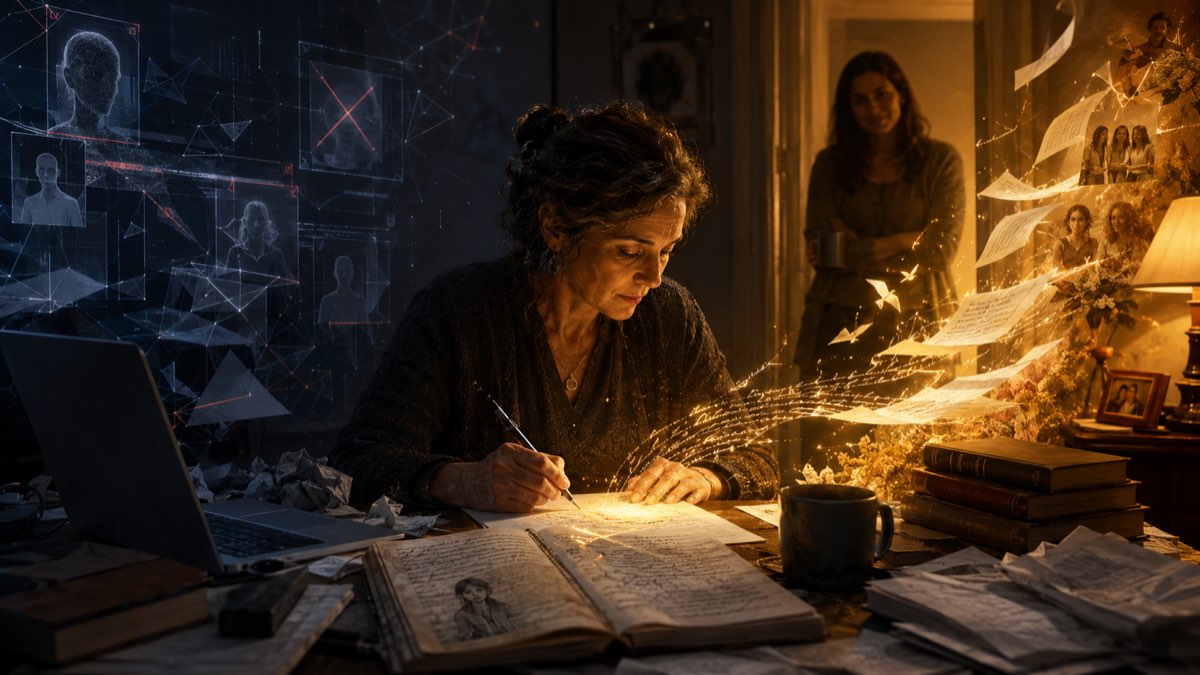
I was a writer long before AI became a reality rather than science fiction.
I’ve been a storyteller since I was 3 years old, and a writer since I was 8. Once my mom understood that, she became my greatest cheerleader.
My Mother Tried to Talk Me Out of It
Not at first. When I was in the third grade, she found a story I’d written in a lined notebook and promptly freaked out because she didn’t understand that the character I was writing wasn’t me. I mean, the runaway in the story embodied how I might feel in a particular dangerous situation and those written feelings were how I tried on that situation and shed it, but I had no plans to run away. To alleviate her fears, she tried to convince me NOT to write.
That didn’t work.
Eventually, she wanted to read everything I wrote, something I understand now as the mother of creative daughters. I can love their art and love to watch them work, hopefully without telling them how to make their art or what it “should” be.
The Years That Made Me a Writer
When I was 12, I was already writing “novels” that my English teachers insisted on taking home to read. They all encouraged me.
When I was 14, my English teacher at a new school told me she would never be as good a writer as I already was.
When I was 16, I wrote a weekly column for four local newspapers and occasional columns for a regional paper.
When I was 18, I wrote and self-published a chapbook anthology that earned kudos from the Rhodes Scholarship state committee even though this country bumpkin didn’t make it to the National round of interviews. It was my personal essay, though, that got me to the state interviews, not my connections or non-existent help from my university which supported more outgoing candidates and campus leaders.
When I was 28, with a six-month-old baby under my feet, a husband, and a full-time career in Acquisition, I couldn’t have been busier, but I decided I had to make time for my writing dream or I would never “get around to it” and I’d still be making excuses in my 90s for not having time to write. I sold my first novel, the fifth I’d written as an adult, a few years later, to a major publisher, and it hit high on the bookseller bestseller lists under a pen name.
My mom was my cheerleader through every word I wrote, including every essay and professional article, and every novel. She also guilt-tripped me for books that editors wouldn’t buy that she loved and she fretted over the villain’s profanity as if it was from my own mouth and not a fictional bad guy’s. She had wanted me to be a concert pianist, but my fate was more with words than music.
The Cheerleaders Who Were Really Gatekeepers
My romantic partners throughout my life liked to style themselves as my biggest cheerleaders, but it was less about me and more about them. My then-husband had copies of my published books in his office, but never read them until after I filed for divorce. His coworkers were excited about them, but his response was always unenthusiastic. I stopped writing for a while after I excitedly told him a woman-in-jeopardy/Southern Gothic novel my editor wanted to see a proposal on.
“Who would want to read THAT?!” were his exact words that crushed me. His primary reading genre was military history, not women’s fiction, but he had lots of suggestions about historical novels I should write instead of what I wanted to write and excelled at.
Other partners later were much the same—intrigued by how I made my art, but after high praise, they decided that they should get to decide what I wrote and didn’t write. Not as an editor or part of the creative process, but as control freaks. Bad enough that my employer, the U.S. Government, could dictate for years what and where I published, but from my own closest circle? So much of my writing life has been Sisyphus pushing that boulder up a hill again and again, fighting for the time to write in scraps during the day and whole chapters while everyone slept, only for some gatekeeper or wanna-be gatekeeper at the top to kick both my boulder and me back to the bottom to remind me who had the power over my words.
Now It’s the AI Witch Hunts
It feels like that now with all these AI witch hunts. These so-called detectors, one popular one in particular, are just machines judging humanity based on a narrow band of what human writing looks like. I feel like a lot of potential readers have just discovered em dashes and triplet cadences in the last year, unlike those English majors among us who were using language outside that narrow band decades ago. I’ve only, since retiring from my other career, enjoyed having the time to write and putting as many hours toward my dream as I did to overtime as a public servant. But instead of enjoying it, I’m expected to waste my precious time proving I wrote every word, mostly by people who’ve never met me and never paid a bill I’ve incurred.
I’ve run my work through the “detectors,” and the most popular one says my paragraphs from a decade ago, and two decades ago, and three decades ago, and even four decades ago, were all written by robots. It’s frustrating. I don’t care how others use AI in their jobs because I’m not going to gatekeep like it has been done to me. It’s the witch hunts and supposed “truth” these detectors sell that annoy me, and it’s just one more group of people trying to tell me what to write and what not to write and how to write and aiming their judginess at me when I just want to tell my stories and work out life’s problems through the construct of my fiction: women getting back on their feet and starting over, women healing childhood tragedy, women losing their mothers to dementia, women grieving the loss of a partner, women finding love again, women just … dealing.
But if the machine decides I’m not a real girl, then the platform and the witchhunters suppress what I have to say.
What My Daughter Told Me
Last night, I was hanging out with my older daughter and griping about this growing frustration and the false positives and false negatives of these detectors, and she said something that made me cry when I got back home.
You see, since that night at Lewbo’s in Niceville, Florida, when my then-husband said, “Who’d want to read THAT?” it’s not been my practice to ask family members or romantic partners to read my stories. If they asked, that was fine, but other than my mom, most let an insisted-upon free copy of a newly published novel sit on their bookshelves where they could point to it when guests came over, having never actually read it, because the spines were never cracked and the front page still made that cracking noise when I opened it years later. So at some point, I stopped sharing that part of myself.
I hadn’t realized until last night’s conversation that my daughter had read so many of my books. My exes all taught me that it’s not something to expect and the response will likely be critical rather than supportive. I’d certainly never realized that my books sound like me. Not just authorial voice but a reflection of spoken conversation and ideas.
She told me when she reads my books, she hears the words in her head—in my voice.
At a time when I’ve been worried about how my voice may be suppressed by gatekeepers, it was exactly the thing I needed to hear.
If you’d like to hear that voice for yourself, a number of my novels are free to read in my online Library.