
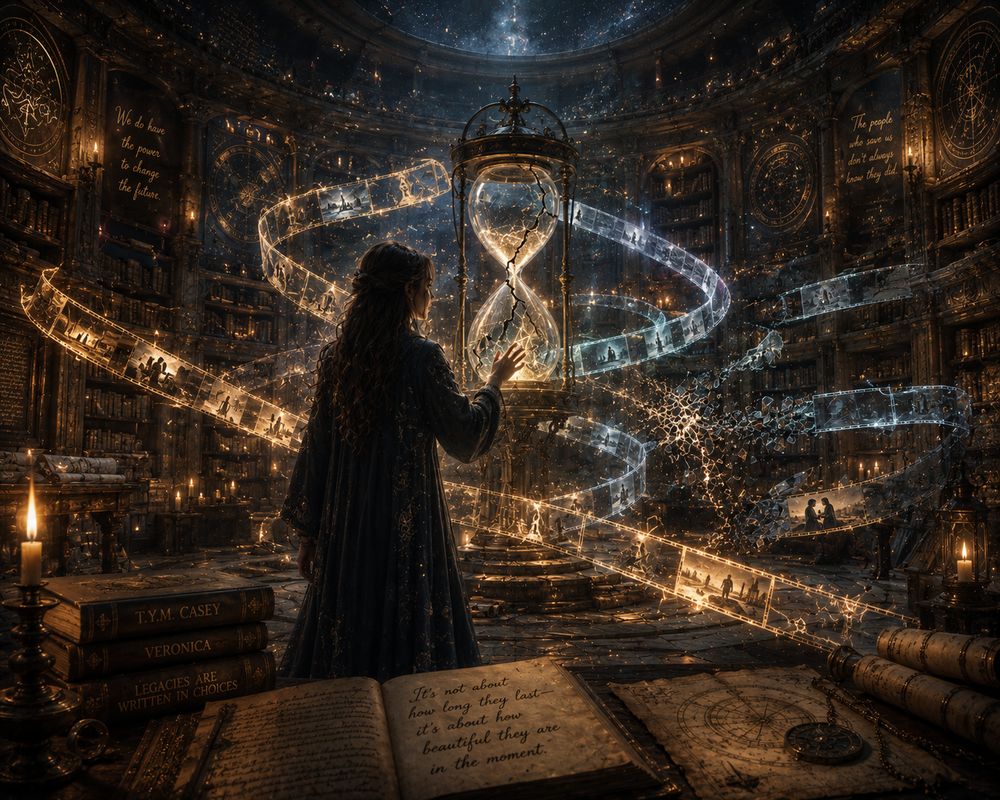
What if the future isn’t fixed, even when you think you’ve seen it?
In writing Turn of Earth, I found myself circling the same questions Maeve did—questions about fate, time, and the quiet consequences of love. I didn’t start out with answers, but as Maeve’s story unfolded, I ended up learning a few things right alongside her.
Here are some of the most powerful truths the book revealed to me—not just about the characters, but about myself, and maybe about you, too.
Turn of Earth — Maeve’s story — hiding in time to protect a future she’s already seen. Browse the bookshelf →
1. We’re Not as Trapped by Destiny as We Think
Maeve begins her journey believing in fixed fates: that what’s remembered is already written, and her job is simply to protect the version of the future she’s seen. But life—and love—rarely follow neat timelines.
In one heartbreaking shift, her attempts to secure that future instead lead to its unraveling. What she—and I—came to realize was this: we do have the power to change the future, even if we’re only beginning to understand how. Sometimes, the stories we cling to are just one possible version, and the truth is, we’re writing new drafts every day.
2. Small Choices Echo Across Time
There’s a scene that still hits me every time I revisit it: Maeve, as a child, eagerly sharing the existence of a hidden archive with Lady Moira. A gesture of enthusiasm and trust.
But that single moment, years later, becomes the catalyst for disaster. The archive burns. The timeline shifts. And Maeve is forced to face how her own innocent desire to belong inadvertently triggered the thing she most feared.
It’s a hard truth: sometimes, we cause harm without meaning to. And yet, if we’re willing to face that, we grow. We forgive ourselves. We begin again.
3. Legacy Isn’t Just About Survival
Maeve is obsessed with preservation—of knowledge, of safety, of Veronica’s path forward. But what she learns, in the quietest of moments, is that legacy isn’t about what lasts.
It’s about what we love enough to leave behind.
A story. A song. A seed of belief in someone else’s strength. These things fade from the record but not from the soul.
As she puts it: “It’s not about how long they last—it’s about how beautiful they are in the moment.”
4. Love Doesn’t Need a Timeline to Be Real
Maeve names her archive “T.Y.M. Casey,” a hidden tribute to a man who was once her only friend. She never sees him again. He never knows how he shaped her. But her actions ripple across time to protect his family.
This, to me, is one of the deepest truths the book offered: the people who save us don’t always know they did. The way we love them back might unfold in quiet, unseen ways.
5. Age Brings a Bittersweet Kind of Clarity
Toward the end of her life, Maeve gets to see her past—and herself—through older eyes. She no longer sees her enemies as monsters. She recognizes the affection that once felt like friction. She sees the girl she used to be with tenderness and grief.
That’s what time does. It gives us perspective. If we let it, it gives us peace.
Why I’m Sharing This Now
Turn of Earth is a speculative fiction novel, yes, but it’s also a letter to myself—a way of saying: your choices matter, even when no one sees. It’s a love note to anyone who’s ever wondered if it’s too late to change things, to make amends, or to start again.
Maybe this post finds you in that space.
If so, consider it a soul breadcrumb.
For more on the stories behind my books, visit the Book Talk page.
A story of love, sacrifice, and the quiet courage of living in the past to save the future.
Visit the Book Page →