
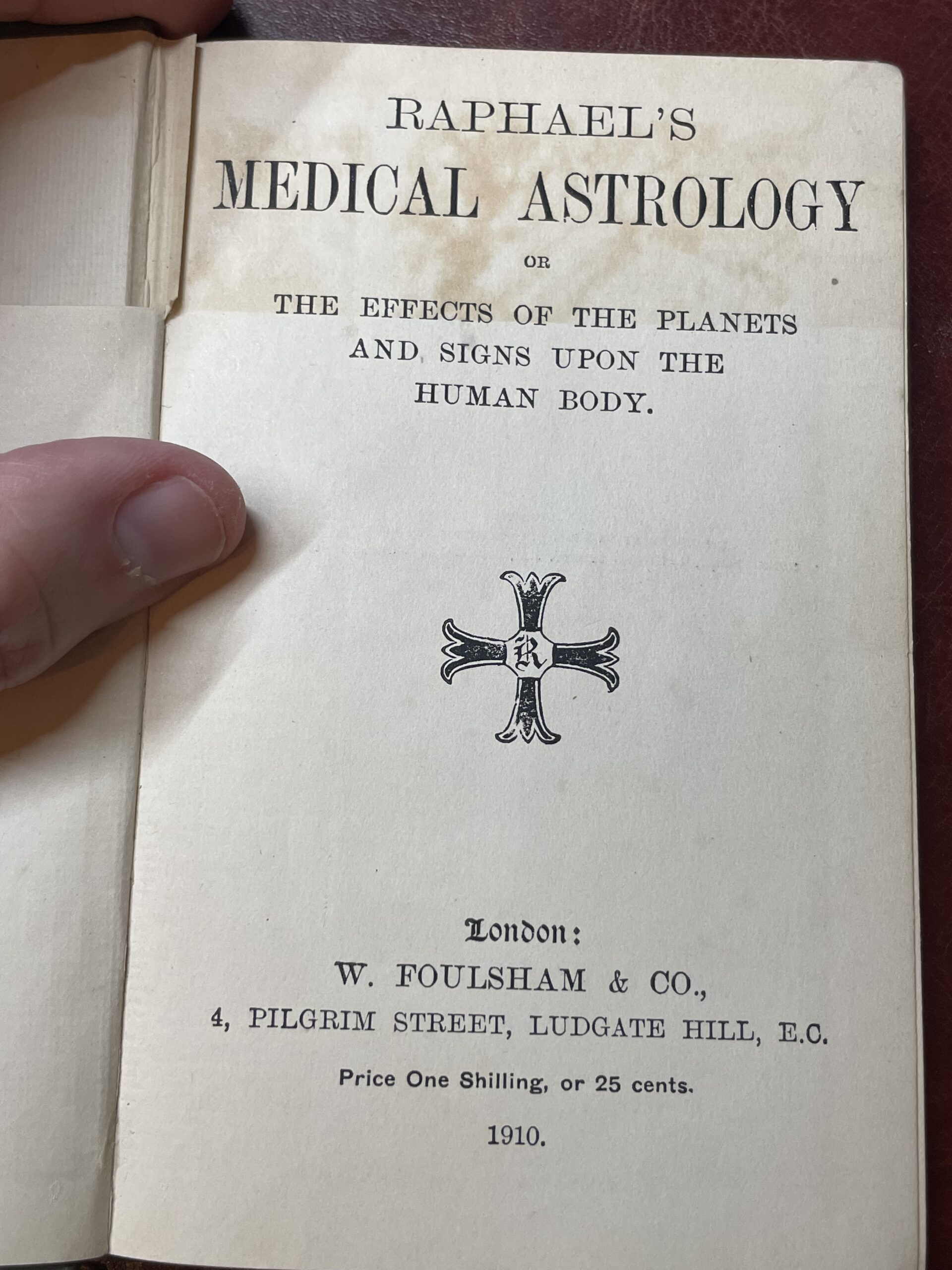
There’s a book on my shelves small enough to disappear between its neighbors. Pocket-sized, plainly bound, eighty-eight pages. It’s called Raphael’s Medical Astrology, and packed inside it is an entire system connecting the planets and signs to the organs of the body, illness, diet, herbs, mental health, accidents, longevity, even the likely course of a disease.
The full title is Raphael’s Medical Astrology; or, The Effects of the Planets and Signs Upon the Human Body, published in London by W. Foulsham & Company, first edition 1910. It stands about fourteen centimeters tall, small enough to ride in a coat pocket, and the title page priced it at one shilling in Britain or twenty-five cents abroad. That price tells you what it was: a working manual meant to be carried and consulted, not an expensive occult showpiece.
Its size is almost the least interesting thing about it.
Raphael Was Not One Person
The name on the cover looks like an author. It’s actually a mantle.
The first astrologer to publish as Raphael was Robert Cross Smith, born in 1795. Smith took up the name in 1824 while editing The Straggling Astrologer (later reissued as The Astrologer of the Nineteenth Century), then went on to edit The Prophetic Messenger, the almanac that helped revive popular astrology in nineteenth-century Britain.
When Smith died in 1832, the name didn’t die with him. Other astrologers inherited the almanac, the ephemeris, and the identity. At least seven nineteenth-century astrologers carried the name, and the succession gets murky because some of them edited the same publications and some signed variations like “Edwin Raphael.” Raphael stopped being a pen name and became something closer to an office.
The choice of name was no accident. The archangel Raphael is the healing angel; the name is usually read as “God heals.” Occult writers also paired him with Mercury, the planet of knowledge, calculation, and astrology itself. For an astrologer writing about planetary medicine, you couldn’t invent a better byline.

Which Raphael Wrote the 1910 Book?
Almost certainly Robert Thomas Cross, the Raphael in office at the time. He is not the original Robert Cross Smith, though whoever arranged for those two names to be that similar owes book historians an apology.
Cross was born in Norfolk in 1850 and started studying astrology young. In the 1870s he took over The Prophetic Messenger and acquired the rights to Raphael’s Ephemeris. He published a two-volume Guide to Astrology in 1877 and 1879, and by 1893 his almanac was reportedly selling around 200,000 copies. That is not a readership of robed initiates. That’s ordinary households.
Cross believed astrology belonged in ordinary hands: cheap, practical, stripped of unnecessary math. Medical Astrology shows it on every page. It doesn’t read like a secret manuscript for an initiated order. It reads like a compact household reference for the astrologically inclined.
He was also wired into the astrological establishment of his day. When Alan Leo founded an astrological society in London in 1896, Cross served as its vice president. Leo went on to shape modern astrology; Cross represented the older strand, predictive and practical, tied to almanacs and ephemerides and the business of daily life.
A Much Older Medical Tradition
The book came out in 1910, but the system inside it was already ancient.
Medical astrology rests on the idea that the body is a microcosm of the heavens. The twelve signs govern regions of the body; the planets govern organs, processes, temperaments, and types of illness. The “Zodiac Man” of medieval medical manuscripts maps it out: Aries rules the head, Taurus the neck, Gemini the arms and shoulders, Cancer the breast and stomach, on down the body until Pisces reaches the feet.
This wasn’t fringe knowledge. Astrology sat inside European university medical curricula from at least the thirteenth century. Physicians used it to diagnose, to judge how a disease would run its course, to prescribe, and to time procedures like bloodletting. Medical almanacs bundled calendars, planetary tables, herbal lore, anatomical diagrams, and practical health advice into a single volume.
After about 1700, astrology lost its standing in professional medicine, though ideas about lunar and planetary influence on the body lingered in both learned and popular practice well into the nineteenth century. So Raphael’s Medical Astrology wasn’t proposing anything new in 1910. It was carrying a very old system forward for a new century’s readers.
What Is Actually Inside the Book?
For eighty-eight pages, the table of contents is ambitious.
The first part covers astrological symbols, aspects, signs, and planetary principles, then assigns the parts of the body to the zodiac. From there it works through planetary rulership, health and constitution, the Hyleg (the traditional “giver of life”), the duration of life, the Sixth House, mental disorders, accidents, deformities, and death. Individual chapters assign classes of disease to Mercury, Venus, Mars, Jupiter, Saturn, Uranus, and Neptune.
The second part reads more like a domestic health manual: health and the horoscope, diet, prevention, herbal remedies, the herbs belonging to each planet, lunar influence, the course of disease, the use of colors. There is even a chapter called “The Family Doctor.”
The inclusion of Uranus and Neptune is the tell. This was no photographic reprint of a medieval system. The author was extending traditional medical astrology to cover planets the medieval physicians never knew existed. Uranus gets the nervous system, the brain membranes, the spinal cord, and what the book calls the “physical aura.” Neptune gets hypnotic, psychic, fluidic, and drug-related conditions. You can watch traditional astrology adapting itself, mid-book, to a modern vocabulary of nerves, psychology, and invisible forces.
The preface is direct about how the book is meant to be used. Identify the planet behind an illness, then apply a remedy of the opposite nature. A Mars condition gets herbs of Venus; a Saturn condition might call for herbs of the Sun. That’s the old doctrine of sympathy and antipathy, in which planets, plants, organs, elements, and temperaments are linked in long chains of correspondence.
Why Publish This in 1910?
Because in 1910, two worlds were pulling apart.
Professional medicine was racing toward laboratory science: bacteriology, standardized pharmaceuticals, specialization. At the same time, Britain was deep in a revival of astrology, spiritualism, Theosophy, ceremonial magic, herbalism, and mesmerism. Astrological magazines, cheap manuals, almanacs, and postal horoscope services were putting material once locked in specialist texts into anyone’s hands. Robert Thomas Cross was a creature of that publishing culture.
Medical Astrology sits squarely between the two worlds. Its language sometimes sounds like an elementary medical handbook, discussing infection, heredity, climate, diet, accidents, mental strain. But every observation lives inside a cosmology where signs and planets govern the body’s vulnerabilities. That is exactly what makes the book valuable as history. It preserves the moment when the old correspondences between heaven and body hadn’t vanished but were being rewritten in the language of modern nerves, constitutions, and preventive health.
Is a Copyright 1910 Copy Necessarily a First Edition?
Not always, and this is where collectors need to slow down.
The true first edition came from W. Foulsham & Company at 4 Pilgrim Street, Ludgate Hill, London, and surviving first-edition title pages are printed with the 1910 date. Foulsham reissued the book as a second edition in 1924 from its later address at 10 and 11 Red Lion Court, Fleet Street, then a third edition in 1932 and a fourth in 1937. All of them kept the same title and stayed at roughly eighty-eight pages.
So the publisher’s address and the edition statement matter more than the copyright date. A copy listing 4 Pilgrim Street with a printed 1910 date is likely the first edition. A copy listing 10 and 11 Red Lion Court is probably the 1924 or 1932 edition, even if the 1910 copyright is mentioned elsewhere in it.
The later editions are part of the story, too. Cross died in 1923, and readers kept buying the book for another decade and a half after him. This was no Edwardian curiosity that appeared once and vanished. It stayed useful enough to its audience to justify four printings.
The Longer Life of Raphael
The Raphael identity outlived Medical Astrology altogether. Raphael’s Ephemeris, descended from the almanacs of the original Robert Cross Smith, kept going under successive editors and publishers, and new editions are still being issued in the twenty-first century. Two hundred years and counting for a name first adopted in 1824.
That continuity changes how I look at my little copy. It isn’t an isolated antique or a quaint pile of outdated medical claims. It belongs to the publishing lineage that carried astrology from the nineteenth-century revival into the modern era, and my copy is one small link in that chain.
It’s also why I collect old books in the first place. They preserve more than information; they preserve entire ways of organizing reality. In Raphael’s Medical Astrology, the body is not separate from the heavens. Health is bound up with temperament, diet, herbs, color, environment, planetary motion, and the moment of birth. Whether or not a modern reader takes that system literally, the book is a compact record of how generations of people made illness understandable by placing it inside a larger, more orderly universe.
For such a little book, it carries a remarkably large history.
If old astrology books are your weakness too, several of my astrology-related novels and antiquarian artifact related novels are free to read in my online Library.
Where does fate enter your chart? The Vertex marks it—and the encounters that activate it.
Visit the Book Page →