
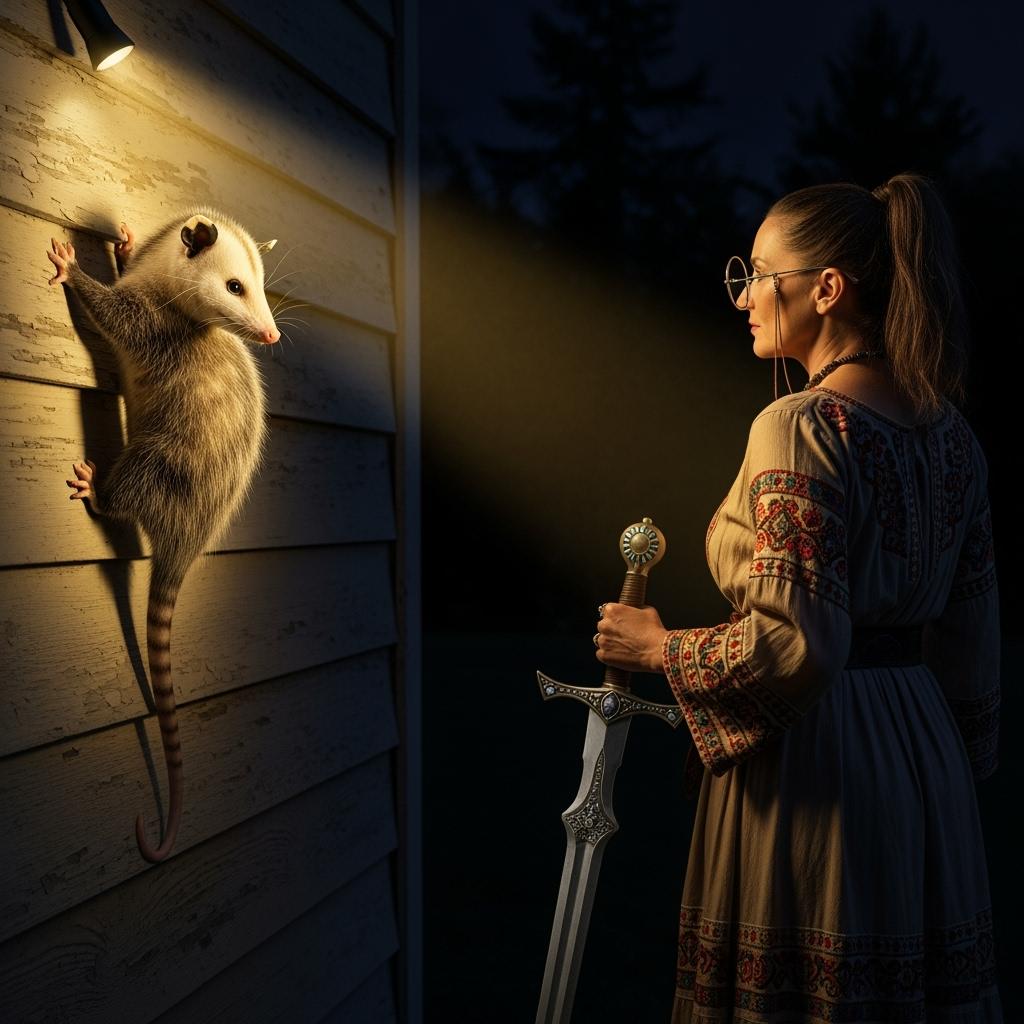
There’s something about the hours just past midnight when the veil between ordinary and sacred grows thin enough to step through.
Last night, I heard a noise outside my office window, sharp and unsettling, the kind of sound that makes your spine straighten and your mind immediately catalog potential threats. Someone trying to force their way in, maybe. Or something falling that shouldn’t have been able to fall. When the metallic rattle was followed by a solid thud against the house, I grabbed the flashlight from my desk drawer and my broadsword from its sheath and stepped out into the thick summer dark.
Yes, I did say broadsword.
There it was, clinging to the weathered siding just below the window frame: a smallish opossum, young but not quite a baby, its eyes reflecting my light like twin coins. We regarded each other for a long moment, this nocturnal visitor and the human who’d come to investigate its intrusion. By the time I thought to grab my camera, it had melted back into the night with the kind of silent efficiency that makes you question whether you saw anything at all. No trace, no photo. Only the impression it left behind and the certainty that something significant had just occurred.
Encounters like these carry weight in ways that logic can’t quite explain. In traditions older than the suburbs we’ve built over ancient pathways, animals who cross our paths, especially in liminal spaces and times, are seen as messengers carrying medicine we didn’t know we needed. The opossum, in particular, has long been recognized as a powerful totem of deception, survival, and unconventional strategy.
What Opossum Magic Teaches
Unlike predators that meet challenges with tooth and claw, the opossum survives by what others might mistake for cowardice. When threatened, it doesn’t fight or flee: it plays dead so convincingly that even its body temperature drops and its breathing nearly stops. This isn’t weakness masquerading as strategy. It’s ancient wisdom disguised as surrender.
Opossum magic teaches us that sometimes the most powerful stance is the one that appears powerless. That strategic withdrawal can be more effective than any frontal assault. That adaptability trumps aggression, and that surviving with whatever’s at hand often matters more than having the perfect tools for the job.
Like Coyote or Raven in other traditions, Opossum walks the trickster’s path, reminding us that cleverness and misdirection often accomplish what brute force cannot. It’s the energy of the underestimated, the overlooked, the one everyone dismisses until it slips away with exactly what it came for.
The Teaching from My Encounter
That night, I brought light to what initially felt threatening. And in the flashlight’s steady beam, the danger dissolved into something small, vulnerable, and ultimately fleeting. When I tried to capture it with the camera, to pin down proof of the encounter, it slipped away into shadows, reminding me that not all magic can be documented or preserved in digital files.
The teaching felt immediate and clear: sometimes the things that unsettle us at our boundaries aren’t dangers at all, but lessons pressing for attention. Shine light when you need to see clearly, stay present for what wants to be witnessed, but don’t insist on proof. Allow what is fragile or half-formed to retreat and grow in its own time until the moment is right for fuller revelation.
Living the Lesson
If Opossum has been showing up for you, whether in chance encounters, persistent dreams, or symbols that keep catching your attention, it may be offering medicine around patience and subtlety. Perhaps it’s time to let certain dramas play out without your direct involvement. To withdraw strategically when engagement would only drain your energy. To trust that survival doesn’t always require strength or speed, but sometimes calls for wit, perfect timing, and the profound wisdom of knowing when to let go.
In a world that often rewards the loudest voice and the most aggressive stance, Opossum whispers a different kind of power: the strength found in yielding, the victory hidden in apparent defeat, and the deep magic of disappearing completely until you’re ready to be found.

Featured Collection: Rites of Passage Trilogy
One woman. Three stages of transformation. A journey of magic, resilience, and healing.
Visit the Book Page →
Southern Gothic, Book One of the Rites of Passage: magick, betrayal, and a reckoning.
Visit the Book Page →