
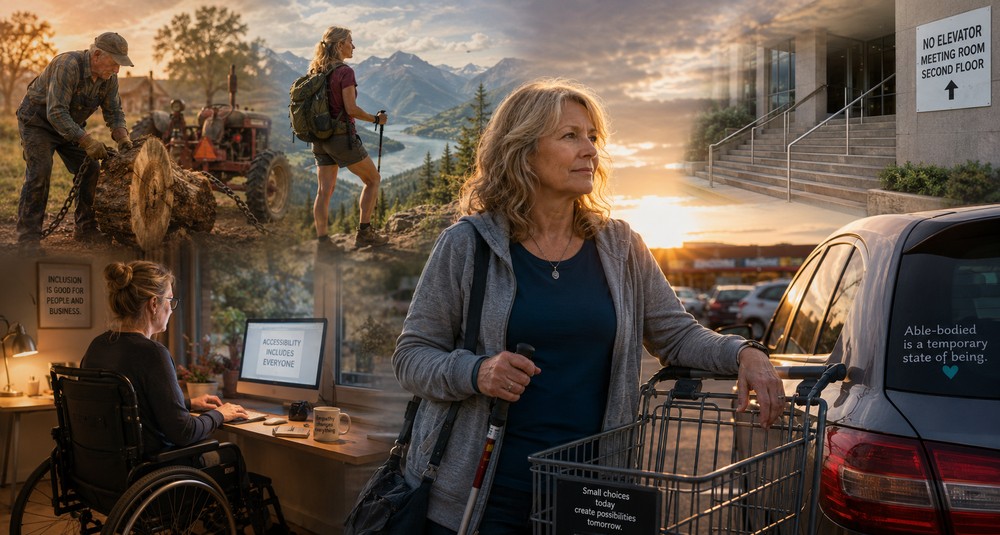
“Able-bodied is a temporary state of being,” a friend with disabilities once told me.
I don’t know if she was quoting someone, if she made it up herself, or if it was simply a natural statement that came out of our casual—but always profound—conversations. It made me stop and think.
I had always thought of disabilities in a certain way. In general, I had always been in excellent health myself, even though I didn’t really think of it that way, and I certainly didn’t appreciate it that way.

Rite of Letting Go — a story about releasing the past and stepping into who you’re becoming. Get it direct from the author → Or read it free in my online Library.
Back in high school and college history classes, we read about how certain groups of people in certain countries actively and aggressively sought to remove anyone with a disability—mental or physical—from their populace.
As a kid, I probably had certain visible disabilities in mind. But I grew up in a community and in a home where we didn’t look down on someone who wasn’t able-bodied.
When My Own Health Changed
Maybe I’m just more mentally aware of what’s going on since my own chronic illness hit out of nowhere. I went from excellent health overnight to monitoring all my vitals multiple times a day in order to manage my health—and to manage it with fewer pharmaceuticals, each of which had multiple distressing side effects.
I learned about invisible disabilities, and I even once or twice argued with someone who thought I should walk all the way across a parking lot to return a shopping cart when, after thirty minutes in the store and the walk back to my car, I was doubled over in pain and in one case, had blood running down my leg after a surgery. It used to be so easy to return carts to the storefront when the store didn’t bother to have a corral that wasn’t at its front door.
I never thought about those things because I never had to think about those things.
It was easy to assume that everyone else—everyone else—approached a situation from the same physicality as I did.
After I began dealing with my own out-of-the-blue health issues, they shaped my career path and coincided with my decision to retire from a decades-long career and take a better position with a nonprofit company that allowed me to work from home.
Working from home was absolutely the best accommodation for the physical barriers I was experiencing, because it was easy to adjust my daily work tasks to match whatever diet, exercise, nap, or other support I needed to be at my best on the job. This was before 2020.
The Accessibility Work
I even worked on special projects related to accessibility, because I was new to understanding how accessibility can give you some of your life back after productivity has been taken away.
I’m really proud of the work I did. I was able to make it easier for small businesses to find important new work and for their customers to have access to the newest and best solutions to their technology problems.
For example, prior to one of my projects, the organization would invite both small and large businesses to their facility to brief their latest technology. Some of the most innovative ideas came from small businesses, sometimes from one-person firms.
The problem was that the organization couldn’t get to those innovative solutions because they insisted prospective partners provide their initial pitch in person. Not only in person, but on the second floor—specifically, in a second-floor conference room of a building with no elevators.
I talked to prospective partners who physically could not climb stairs, and others who were homebound, even though all of their work could be done remotely on their computers.
I gave this example: What if Stephen Hawking had the answer to your problem, but you required him to show up in person on the second floor of your building for you to find the solution that could save your world?
I think it was probably around 2020 to 2022 that we reached the height of a turning point in empathy, both in dealing with disabilities and in coming up with workarounds. That was the era when people who had been forced to give up or cut back on in-person office work suddenly demonstrated that remote work was not only possible, but effective.
There are plenty of reasons people end up with disabilities that make their lives hard—really hard. Some are born with them. For some, they develop over time. For others, they happen suddenly, such as through an accident. In some cases, we contribute to them ourselves, even though when we’re younger we don’t know how time and genetics will take their toll. Even the best health practices can still yield delayed or unexpected results.
Watching Time Take the Body
But my friend’s statement—that able-bodied is a temporary state of being—made me think about the progression of time and the toll it takes on the average human body.
I remember my mother’s father being strong in his sixties and seventies. I even remember him in his eighties, moving five-hundred-pound stumps with muscle, chains, and a tractor.
But I remember his muscles weakening over time, and how, finally, around the age of eighty-eight, his health started going downhill and he became frail.
I saw the same thing with my mother: how strong she was, and then how, around her mid-to-late eighties, she started becoming weaker, until she, too, became frail in her late eighties.
I remember one of our last coherent conversations, when she told me that it felt like she became weaker every day. I tried to understand because that hadn’t happened to me. Not yet.
And now, like watching the great circle of life and all of its patterns, I’m no longer able to climb onto the roof of the house to check for leaks or haul heavy bags of fertilizer into my garden.
I make accommodations wherever I go so that I’m not lifting heavy suitcases when I travel for research. I always take my hiking stick with me on long treks into the mountains—whether for pleasure or, well, more research.
It makes me think ahead—not to where I am now, but to where I’ll be next year, and in five years, and in ten, and in thirty. Whether I’ll be as strong as my mother was until her eighties, or as strong as her father was until his eighties. The wear and tear on the body alone means that able-bodied is not a forever state of being.
When It Happens Without Warning
I was out at lunch recently with a new friend. Her husband is barely fifty, but an unexpected stroke rendered him almost helpless. All of their plans—his dreams, his high income—were gone in the blink of an eye. He’d been in excellent health before. Or thought he was.
I’ve seen the same thing happen with much younger people in their teens or twenties. Maybe not a stroke, but an accident. Something completely unexpected. Going from perfect or near-perfect health to being unable to live the lives they had imagined.
And yet, somehow, we’ve gone backward in the last few years, to a place where it’s considered acceptable to ridicule someone for their disability, or to tell them that they don’t need—or shouldn’t need, or shouldn’t use—different types of assistance tools. It’s maddening to watch.
But if there’s any schadenfreude in it at all, it’s this: one day, they too will understand—if they survive long enough—that able-bodied is not a permanent state of being. Eventually, they will have to make their own accommodations and hope that others will accommodate them as well, so they can continue to live their best life.
Book 2 of the Rites of Passage Trilogy — some doors only open when you let go.
Visit the Book Page →
Read it free in my online Library →