
There’s good and bad in the world—if you look for it, and if you don’t.
What I’ve noticed, though, is that often the good comes from the people whose responsibility it isn’t to make things right.
Last year, someone gave me a brand-new-with-tags MM LaFleur dress because it was too small for them and they couldn’t return it. It was a nice thought, but it turned out the dress was also too small for me. They suggested I sell it or trade it for a different MM LaFleur dress. I never quite got around to that, except to put the dress up on a secondhand website—where I promptly forgot about it.
A few days before Christmas, I got a notification that it had sold. Not only had it sold, but it sold for close to the original full price. I hurriedly packaged it up and decided to take a walk later that day to the post office to mail it, so I could get some steps in at the same time.
What You Notice on the Way
On my walk over, I noticed a shiny new hubcap that some car had lost. Some kind soul had rescued it from the road and placed it carefully against a pedestal next to the sidewalk, in a spot where it could be seen if the owner came back looking for it.
That was nice of them, I thought.
I’d been in the area earlier in the day, so I knew it must have happened recently, and I hoped the owner would be able to come back and find it. As for me, I continued my walk to the post office to mail my package.
Less than a minute later, I heard a god-awful clatter somewhere behind me, but I didn’t think much of it at the time.
This particular stretch of sidewalk is somewhat precarious, and I’m always careful not to get too close to the edge and trip into the street—because, well, I’m not that graceful. I often walk through that area with a hiking stick, because when the city has to tear up the sidewalk to get to a water main, they don’t always re-pour the concrete immediately. Sometimes they just push the pieces back together, and that becomes a fall hazard.
And yes, I have taken a very dangerous tumble for exactly that reason. I’m grateful I didn’t break my ankle or my wrist, but having been hurt once on that sidewalk, I’m super careful now. Not only could I trip and fall flat on my face, but I could fall out into traffic. So I’m careful.
A few seconds after the clatter, a boy from the local middle school rode past me on his bike, nearly forcing me off the sidewalk before he veered sharply and rode the lip of the curb, swaying back and forth into heavy traffic. I held my breath as I watched him, then stopped. He couldn’t have been more than 12 or 13.
He was soon out of sight, riding ahead to meet up with his friends from the same middle school. And yes, I know they were from the local middle school—I’ve seen them doing stunts on their bikes more than once as they’ve ridden past my house with other boys their age.
Not too far ahead, I discovered the sidewalk was blocked and had to double back. It wasn’t far—just on the other side of where I’d seen the hubcap. I was watching for it as I approached but didn’t see it until I reached the exact spot.
The hubcap was shattered.
Sharp, small pieces and large, jagged ones were strewn across the sidewalk—where only I and the boy on the bike had been in the last few minutes.
I found a different path and headed back toward the post office, eventually arriving at a busy four-way intersection where I waited for the light to cross.
At the Corner
As I stood on the corner, I watched two boys—friends of the boy on the bike, who joined them later—exit a soup-and-sandwich bistro with large drinks in their hands. They stood at the top of the steps, looking down on the street and looking down—literally and figuratively—on an old man waiting to cross.
He was bent and gnarled, able to do little more than hobble. I’ve seen him before, sometimes sitting on a bench in the area where unhoused people sleep. Locals leave blankets and sacks of food there. He paid the boys no attention, even though I’m sure he could see them in the periphery of his vision.
He stood quietly at the corner while the boys towered above him, sipping their drinks and laughing loudly. Then, just as suddenly, they stopped paying attention to him. I was still waiting to cross when one boy lifted his drink high over his head and flung it down the steps so it bounced and splashed like a slinky, liquid going everywhere. He tossed his half-eaten salad into the mess.
The other boy laughed and did the same.
Then they pivoted on the balls of their feet and headed toward the parking lot around the corner.
The old man didn’t even look at them.
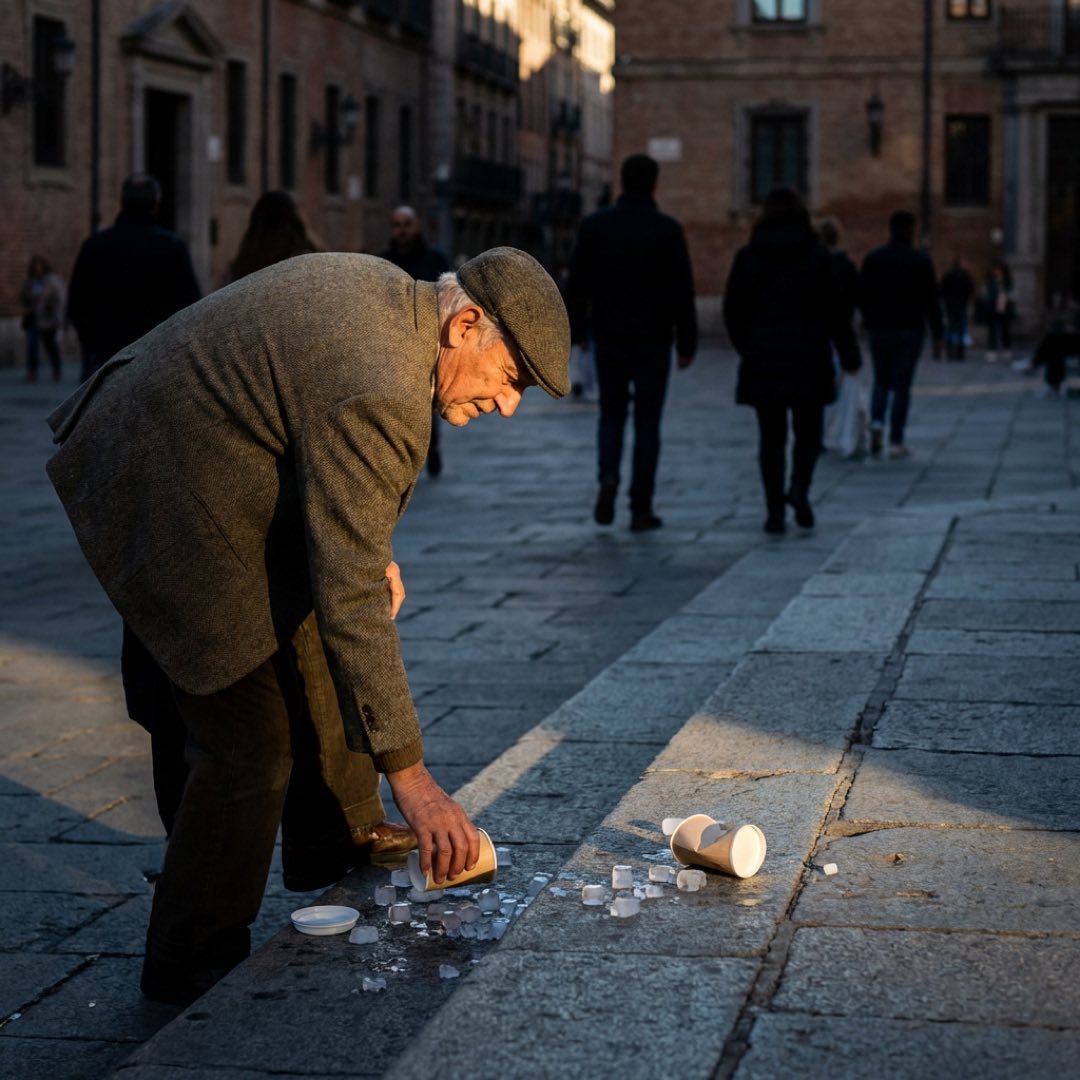
He turned, walked over to the empty cups, plastic lids, straws, and napkins scattered on the steps, and in one smooth motion scooped them all into his arms and threw them into a trash can that had been less than two feet from the boys when they’d thrown their drinks on the ground.
The signal changed. As we crossed the street, he and I nodded to each other in passing.
A few minutes later, after a brief chat with a friendly worker at the post office, I stepped outside to head home. The boys—all middle school age, all on bikes—glanced up at me but didn’t really see me.
There’s something about turning fifty and older that renders you invisible. Or if they saw me at all, it was probably the way they might see a grandparent—like an old man on a corner lot, fist raised, yelling at the sky and demanding they get off his lawn.
Worth Every Penny
Later, I decided to give the money I made from the dress to a man in my neighborhood who had picked up a mess behind my house.
Grueling, sweaty work.
It wasn’t his responsibility. It wasn’t mine either. But it was becoming dangerous, and three other people—who had far more legal responsibility for it than I did—had ignored the situation until I decided something had to be done.
I was grateful for his help. There’s no way I could have done that work myself without landing in the emergency room. I paid him for the job, and then I tipped him the same amount as the profit I’d made from the dress.
He was worth every penny.
And it was worth every penny to me for him to know that he was seen—and appreciated.
When reality-shifting pages erase people from existence, empathic librarian Lilah and the last priest must save a cursed grimoire—and themselves.
Visit the Book Page →